


Perspectives over 20 years
Twenty years is a lot to try and fit into one story. So we didn’t. We asked a few of the people who’ve lived most of it for bits of what they remember – some big moments, some small ones, some things that changed us, and a few lessons learned the hard way.
This isn't the definitive history of DRK LBL. There are hundreds of jobs, people, late nights, questionable decisions and stories missing from it. Consider this an initial rummage through the DRK LBL memory bank.
JOEL
In 2006 I was sure of one thing about this business, and I was wrong about it.
I'd done my six months in a friend's garage learning to screen print, and I was ready to do it properly. The plan was an ad in the Yellow Pages. A few thousand dollars, because that's how you found a business back then… you opened the book.
Another good friend of ours, who was doing internet marketing before most people had heard of it, told me to give that money to Google instead.
I thought he was mad.
Who was going to buy 50 T-shirts from someone they'd never met? I wouldn't have. If it was my money I'd want to see the shirt. Check the fit so I could work out the size breakdown. Hold the fabric. Look at the ink colours on the actual garment, check the print location, and then approve it. That was the only way anyone was going to order a few thousand dollars of printed apparel.
Wrong.
We turned the Yellow Pages ad into a landing page with a mobile number and an email address on it, ran some Google Ads, and waited. The phone rang. People actually emailed. Someone wanted 20 shirts. Then someone wanted 100.
We called people back, answered every question they had, and people paid for shirts they'd never touched and trusted us to get them right.
All this despite what I thought would happen. And it’s still happening today.
We were nice on the phone
The more specific (and romantic) version of this story is that we were nice on the phone – that is, people found our number online and called. We answered, and early on, clients actually told us they weren't necessarily getting “nice on the phone” elsewhere. So we learnt that being ourselves made sense, and worked.
But being nice doesn't get the Pantone right or get deliveries out on time. We did that too.
QC remains a massive part of what we do, but our first quality-control department was solely Jodi. I hated folding shirts, so I'd bring them back to our townhouse and dump them on the lounge-room floor. She'd check them, fold them into sizes and box them up while our newborn daughter did whatever newborns do.
Every garment and every box went through her hands before the courier came.
Ink colour was mixed by eye. A bit of this, a bit of that, in a repurposed aerosol can top until it looked close enough to the Pantone swatch. We got good at it, and it was still a guess.
Registration was done manually and fixed by feel. In 2007 we spent about $1,500 building our own order-management system so clients could log in, upload artwork and see the same information we could see.
None of these things felt particularly profound at the time. We were just trying to improve.
And that's probably one of the things that has stuck. We’re still doing that.
Today ink is mixed to formulas. Screens are imaged computer-to-screen and pre-registered. There’s thin-thread mesh, stencil thickness, single-stroke printing, LED exposure and a whole bunch of other technical, nerdy stuff you don't need to know about.
Nerdy stuff, or boring?
Well, we also learnt that what’s boring to one person may not be to another, while what builds trust is almost the same for everyone. Growing to understand what clients valued and why, then making damn sure we delivered those things, helped us earn their trust.
The point is, the recipe doesn't have a bad day, and neither should the person opening the box at the other end. And thinking like this has meant that over 20 years we've kept finding little variables and working out how to remove them – for ourselves, sure, but ultimately to improve what we produce for the people who trust us to deliver.
Removing variables sometimes meant a new process. Sometimes it meant better equipment. And sometimes it meant listening to somebody who knew a hell of a lot more about printing or business than we did.
Through all this, we learnt that being human is good, being good is hard, and getting better is what we want.
Still do.

JODI
Joel and I had been married for a couple of years when all this started. I was working in retail management, we'd just had our daughter Ezra, and Joel had a cleaning business on the side.
We had a friend, Tracy, with a screen-printing business. Joel thought it looked pretty cool, learnt how to print and somehow that became the beginning of the next 20 years.
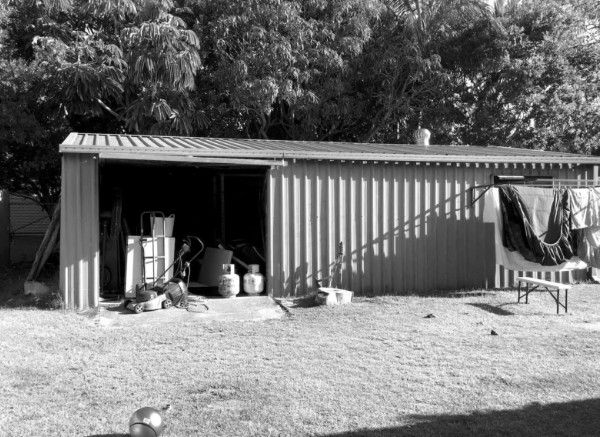
When Ezra was four weeks old, we rented a house with a shed in the backyard, bought our first Adtec manual press and decided to have a crack at making it a business. Joel was printing, doing sales, doing artwork and basically learning every part of it as he went.
Once the website started bringing in work from all over Australia, it began to feel like this could actually be something.
We've always been really passionate about learning, and pretty early we invested in a business coach. He asked us a question that forced us to make a decision:
Do you want to make this real, or make it a hobby?
We decided to make it real.
In about 2008 we moved into our first factory. We're still in the same spot today – we started with one unit and just kept expanding out from there. Although, after nearly 20 years, we're finally moving four doors up in a few months.
Looking back, moving out of the house was probably the first really big jump.
The next one was buying an automatic press.
And that one taught us a few things.
Sometimes the bad machine leads to the good one
Our first automatic press was a demo machine. It was… challenging.
There was a lot of downtime. A lot of technicians fixing things. It was a big step forward in theory, but it also made us realise how important the right equipment was going to be if we wanted to grow.
That experience pushed Joel to start travelling to industry shows in America and looking at what other printers around the world were using. He went deep into the machinery and the technical side of printing and eventually discovered ROQ.
About 11 years ago we bought our first ROQ automatic. It's a serious bit of screen-printing kit, and it was a big risk for us at the time. To this day, it was also one of the best risks we took.
We went on to add another ROQ years later, and the equipment and production side of the business has kept evolving from there.

There were plenty of less predictable challenges along the way too. Like being right in the middle of our peak pre-Christmas production period when the building was struck by lightning and the entire power box caught fire.
You don't necessarily plan for that one in the production forecast.

Our kids grew up around it too
The business and our family have always been pretty intertwined.
My mum was a seamstress, so I grew up around apparel myself. I never necessarily thought I'd end up back in that world, but it's funny how my own journey eventually found its way back there.
Then our kids grew up around DRK LBL too.

There's something pretty cool about looking at that photo now. Ezra was four weeks old when we rented the house with the shed and decided to make a go of this thing.
Now she works here as well.
Twenty years is weird like that.
Nine thousand used to be enormous
I still remember our first really big order. It was for the Equality Australia vote: 9,000 American Apparel T-shirts. There was a full Australia map, heaps of colours in the print, heaps of different garment colours. At the time it felt just incredibly massive.
While we were recalling these memories, there was a 15,000-piece run going through the factory.
That's one of those moments where you stop and realise how much has changed. The backyard shed became roughly 850 square metres of factory, two automatic presses and a team capable of handling work we couldn't have imagined taking on back then.
But some of the stuff I'm proudest of isn't necessarily the biggest.
There are just cool things we've been able to make (these go back a while…).

We live-printed down at Currumbin beach for SWELL Festival. We've printed at industry events and nights with global artists like 123Klan. We've watched people actually experience screen printing instead of only seeing the finished product in a box.

And in 2020 I won the inaugural Global Women in Print Award.

Would I do the whole 20 years again? I'd probably have to have a long think about it.
It's a lot of hard work, a lot of commitment and a lot of energy. But I've loved the journey. I love helping companies and brands and seeing designs come to life on apparel. I'm incredibly proud of the team we have, the clients we work with and what we've built.
And I still think there's something pretty simple underneath all of it.
Everyone wears a T-shirt.
MARY
Sometimes doing whatever it takes means literally that.
There have been a couple of times where we've gone to GREAT lengths to hit a deadline.
Everything's finally printed. It's packed. Somehow we've got the job across the line. Then you look at the courier and think, I'm not trusting you with this.
So we didn't.
We've packed Jodi's car to the absolute brim with stock and driven it there ourselves. The Torian Pro was one. AFL Grand Final merch was another. There have been plenty.
Over the years you learn that our deadline isn't really the deadline. There's an event after it. A launch. A gig. A campaign. A conference. Someone has made a promise based on the promise we've made to them.
When you understand that, “the courier should get it there” isn't always good enough.
We also learnt that 100 hoodies are quite large
There was a period where YouTubers and influencers really started popping off.
We worked with quite a few of them. One guy had done really well, was sitting on some new money and was starting to build his empire. He invested properly in his first range, including around 100 hoodies.
Then he drove down from Brisbane to collect it.
In a coupe.
We had about eight boxes waiting.
It was at this point that everybody realised nobody had considered how much physical space 100 hoodies actually occupy. So the boxes went. The hoodies stayed bagged and we stuffed them into every available nook and cranny of this little sports car.
I thought it was an excellent content opportunity. He did not. There is sadly no video or photographic evidence.
But there was a process change afterwards: tell pickup clients how many boxes there are and maybe ask what they're driving.
Not every lesson from 20 years needs to be profound.
You see a lot from inside a print shop
One of the things I love looking back on is how many different industries, scenes and little cultural moments we've been part of.
There was the CrossFit boom. National touring bands. International touring bands. Indigenous art groups where we've delivered work into super-remote parts of Australia. Political campaigns. Events. Conference swag.
Big 4x4 brands. Moto brands. Influencers, streamers and YouTubers who suddenly realised there was serious money in merch.
Trade businesses that actually care how their people look on site.
Artists and creatives trusting us to translate their work onto apparel, where the artwork is basically their baby.
Hospo brands making sick apparel and discovering their customers actually want to wear it.
Styles come and go, then come back again – we all know that – but through the shifts and changes, it’s interesting seeing all the different jobs apparel can do.
We've learnt a lot by listening
The conversations with clients have always been important at DRK LBL, but I think what changed was realising how much we were learning from THEM.
We listened to what worked. What didn't. What sold. What sat there. What their customers cared about. Then we'd bring those lessons into the next conversation.
Our consultants did that with each other too. We'd share the wins and the challenges, and what one person learnt from a client became useful to someone else.
Do that across hundreds and eventually thousands of clients and you build a pretty useful body of knowledge.
It's not just whatever we reckon. It's actual experience from actual outcomes.
That thinking eventually became a much more deliberate part of DRK LBL through the Apparel Strategy Session.
And some of the experience definitely came from getting things wrong.
Like printing 500 shirts on the front instead of the back because the proof had the front and back layout around the wrong way. We reproduced that mistake very efficiently. Thankfully we had a strong relationship with the client. We understood them, they understood us, and we worked through it.
That's probably another thing you learn over 20 years.
Experience doesn't mean you never make a mistake. It means you've hopefully got enough knowledge, systems and trust around you to know what to do next when you do.
Twenty years later
It's nowhere near the whole story.
There are people we still need to introduce you to. Jobs that deserve their own chapter. Clients who changed how we think. Mistakes we've got to share. Wins that felt enormous at the time and barely get mentioned now. Late nights, new machines, broken machines, ridiculous deadlines, great prints and probably several stories that should remain safely inside the factory.
But that's kind of the point. This wasn't meant to be the definitive DRK LBL history. It was about diving into a few of the brains that have been around the longest and seeing what comes to mind first.
And interestingly, despite remembering completely different things, so far the same ideas keep showing up…
Learn from people.
Take the risk when it's worth taking.
Listen to the client.
Give a shit about the outcome and their deadline.
Own it when something goes wrong. Fix it.
Keep getting better.
Joel and Jodi started with a manual press in a backyard shed and a four-week-old baby. Twenty years later we occupy around 850 square metres of factory, a team that's grown up around the business and jobs going through that would once have seemed ridiculous.
A fair bit has changed.
Still plenty more stories to tell.
Still behind your brand.
About DRK LBL
DRK LBL is a Gold Coast apparel agency and screen printing specialist based in Currumbin, Queensland. Since 2006, we’ve worked behind brands across Australia, combining apparel strategy, design, screen printing, embroidery, retail finishing and fulfilment under one roof. From independent labels and artists to national brands, events and large-scale merchandise programs, we help turn ideas into apparel people actually want to wear.
Looking for screen printing, embroidery or apparel production in Australia? Hit us up.
